Founder
25% off
Use code FOUNDER25 for 25% off Plans or Pro, first 25 orders. Includes a free update to the first field-built revision.
Plans PDF with FOUNDER25Pro with FOUNDER25WOF-100C / BABINGTON CRUCIBLE FURNACE
Rev C — not yet built or fire-tested
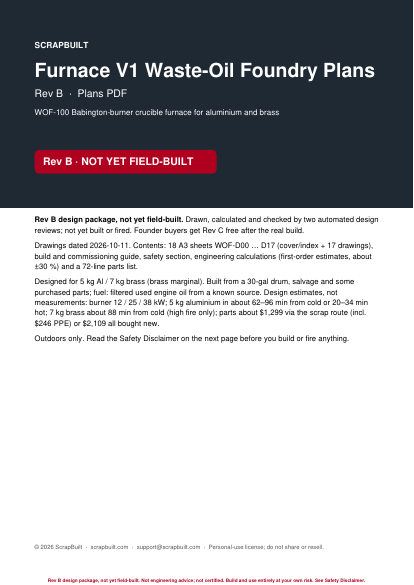
Rev C design package, not yet built or fire-tested. Drawn, calculated and checked by two automated (AI-run) design reviews; not yet built, wired or fired. Founder buyers get a free update to the first field-built revision.
Plans for a known-source used-oil crucible furnace built from a 30-gal drum, salvage and purchased parts, with a UV/safety-relay flame-safety chain designed in. Designed for 5 kg aluminium / 7 kg brass. Rev C design package, not yet built or fire-tested. Use code FOUNDER25 for 25% off Plans or Pro, first 25 orders.
One-time digital download · Metric drawings · Outdoor use only
READ BEFORE YOU BUY
Rev C design package, not yet built or fire-tested. Checked by two automated design reviews (findings fixed on paper). The control wiring must be reviewed by a qualified person, and the bench fault tests with the fuel disconnected are required before any firing.
The 8 open risks after Rev C, from the fix log (section D) at the end of the plans.
Buyers who build it are early builders.
01 / ON THE BENCH
02 / DESIGN NUMBERS
Design estimates only, based on first-order hand calculations (±30%). These are not measured performance results.
03 / CHOOSE YOUR FILES
| Free sample | Founder (code FOUNDER25) | Plans PDF | Pro | |
|---|---|---|---|---|
| Price | $0 | 25% off Plans or Pro (first 25 orders) | $39 | $69 |
| Contents, 1 drawing, parts excerpt, pre-run safety checklist | ✓ | ✓ | ✓ | ✓ |
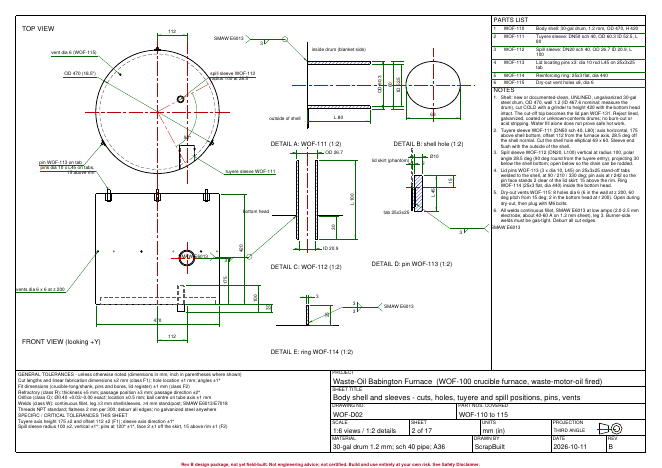
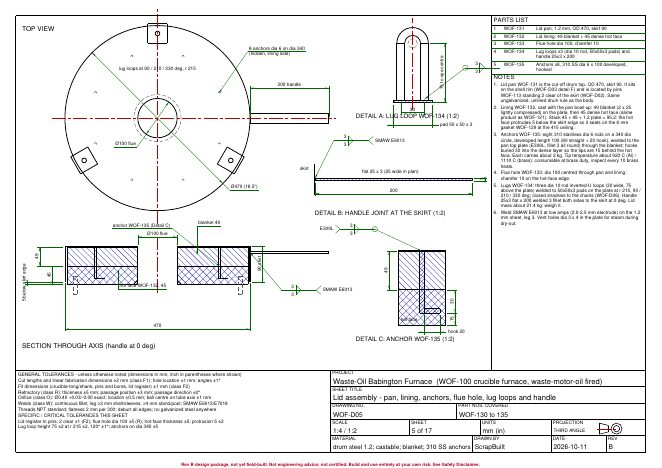
| All 26 A3 sheets (cover/index + 25 drawings) + build guide + safety + calcs + BOM (PDF) | ✓ | ✓ | ✓ | |
| 26 DXF CAD files | with Pro | ✓ | ||
| Parts spreadsheet (.xlsx + .csv) | with Pro | ✓ | ||
| First field-built revision | Free | Discounted | Discounted | |
| 14-day no-questions refund | — | ✓ | ✓ | ✓ |
Prices in USD; tax added at checkout by the merchant of record.
25% off
Use code FOUNDER25 for 25% off Plans or Pro, first 25 orders. Includes a free update to the first field-built revision.
Plans PDF with FOUNDER25Pro with FOUNDER25$39
Buy Plans PDF$69
Buy ProFounder offer: use code FOUNDER25 for 25% off Plans or Pro, first 25 orders. Founder buyers also get a free update to the first field-built revision.
Every buyer gets free errata for Rev C. Founder buyers (code FOUNDER25) get a free update to the first field-built revision; others get a discounted upgrade. No fixed date for that revision.
04 / BEFORE YOU START
No. Furnace V1 is a Rev C design package, not yet built or fire-tested. It was designed, calculated and drawn, then checked by two automated (AI-run) design reviews: one on the numbers (33 findings) and one on the drawings and guide (28 findings). Every finding has been dealt with on paper, but 27 of the fixes can only be confirmed by a physical test on a real build. Four findings on the control wiring are on hold until the actual relay parts are chosen and reviewed. The fix register lists 8 open risks (see below). The first real build is next. Founder buyers get a free update to the first field-built revision, which will include what that build teaches.
Rev C is a paper revision of Rev B. Its main change is a stronger flame-safety chain:
It also has:
Rev C costs more to build than Rev B. The flame-safety chain is a design feature, not a safety guarantee: it has not been wired or tested, and no certified safety rating is claimed.
Only if you want a detailed, documented starting point and are comfortable building from an unproven design. Founder pricing (code FOUNDER25: 25% off Plans or Pro, first 25 orders) reflects the risk. If it is not what you expected, you get your money back within 14 days, no questions.
Nothing has been melted in it yet. It is designed for a 5 kg aluminium charge of recovered metal (dry, crushed cans, added in small batches) or a 7 kg brass/bronze charge.
The fix register lists 8:
No wiring/firing release yet. The exact compatible relays, safety-relay inputs, air-switch contacts and UV-control terminals are not yet chosen or reviewed. The custom 120 V control panel needs a competent, component-specific electrical review and fuel-isolated bench fault tests before it is wired or fired.
Flame, air and oil safety depend on tests on the real build:
The ≈ 17 mL of oil released on a flame failure is a model figure.
The lining's temperature margin is conditional, and the castable datasheets govern. You need a non-oil heat source for dry-out. The chamber must stay ≤ 1200 °C, the hot spots ≤ 250 °C and the lid-tab skirt ≤ 450 °C. Inspect after heating cycles. There is no measured efficiency.
The lifting tools are unproven and the lid motion is conditional:
Adding cans needs a full stop, purge and relight, which depends on working controls. Drying cans never proves hidden cavities are dry. Stop after a second unplanned lockout.
Several things must be measured on site:
Welding on the thin drum is avoided by design, but the structural welds, bolts and added brackets and tools still need inspection.
Costs are estimates ($1,556 scavenged / $2,840 bought) and above Rev B. The real controls, a dry-out heat source, local materials, shipping and tax may raise them.
These are model estimates:
These are first-order calculations (about ±30 % or worse), not measurements.
About 1.2 / 2.6 / 3.9 litres per hour at low / normal / high fire (12 / 25 / 38 kW), and about 3.2 L for one cold aluminium melt at normal fire (model estimate). The 20 L tank lasts about 5 hours at normal fire. Log your real fuel use; the savings over Rev B are model numbers.
The 85-line parts list estimates about $1,556 using salvage and scrap where sensible ($1,310 build + $246 of PPE), or about $2,840 by the cheapest buy route. The buy route still uses some tested used/surplus items, such as the UV parts and safety relay; buying those new retail brings it to about $3,150. The scavenged route also includes purchased parts:
Prices are estimates and were not quoted. The Pro spreadsheet lets you enter your local prices.
If any of that is new to you, get an experienced person involved.
Filtered used engine oil from a known, traceable source. That means not "free oil" of unknown origin: the guide says to reject any oil you can't vouch for. A Babington burner atomizes it. The oil is settled for at least 7 days, then filtered through a 100-micron sock and a 100-mesh strainer. Burning used oil is regulated or banned in some places, so check your local rules first.
No furnace that burns oil and holds molten metal is "safe". The safety measures are:
It is not certified and not professional engineering advice, the flame-safety chain has not been wired or tested, and you build and use it at your own risk. Outdoors only. Read the Safety Disclaimer before buying.
Pro adds the 26 DXF CAD files (cover/index + 25 drawings) and the parts spreadsheet (.xlsx/.csv). Take Pro if you use CAD, have parts cut by a shop, or want to price the build.
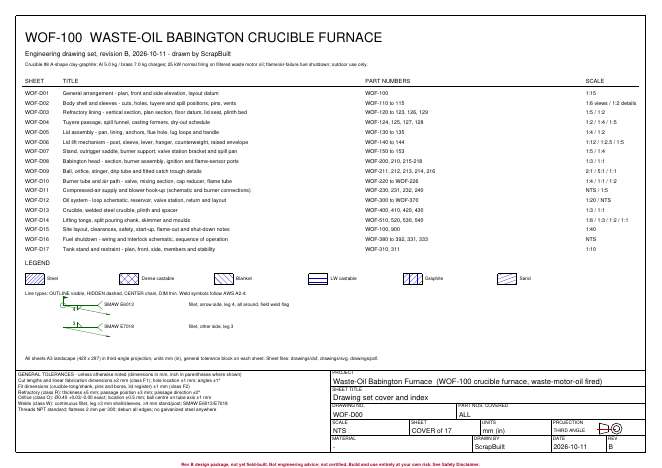
The Plans are a PDF: 26 A3 sheets (cover/index + 25 drawings), plus the guide. It prints fine at A3 or tabloid and is readable on screen. Pro adds DXF R2010 in mm, XLSX and CSV.
Millimetres, kg and °C, with imperial in brackets where useful; pipe and fittings use the US sizes you buy them in.
Yes. Castings and items you make with a furnace built from these plans are yours to sell. What you can't do is resell or share the plans or files, or sell furnaces built from them as a product without a commercial license.
No. The license is for one buyer. Your friend can buy their own copy, or get the free sample first.
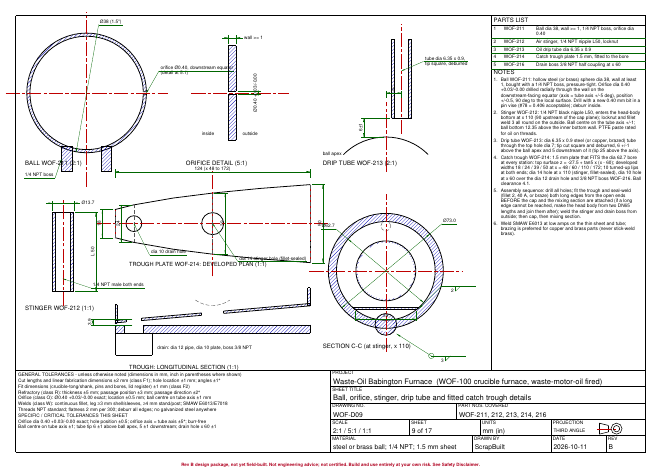
The cover, the full contents, one complete drawing sheet (WOF-C-D01 general arrangement), a parts-list excerpt and the pre-run safety checklist.
14 days, no questions: email us or reply to your receipt. Founder buyers can also get a refund if no field-built revision is issued within 12 months of their purchase.
After the first real build and commissioning. There's no fixed date, and progress will be posted in public.
Our merchant of record (Gumroad) processes payment, adds and remits sales tax/VAT where required, and delivers the files instantly by download link and email.
Please email [email protected]. Confirmed errors are fixed in free errata for Rev C for every buyer.
The cover, the Safety Disclaimer, the first page of what changed from Rev B, the full contents, the drawing index and one complete drawing sheet (general arrangement), a parts-list excerpt and the pre-run safety checklist.
Get the free sample ($0+)Gumroad captures the email.
05 / MORE FROM SCRAPBUILT
Rev A design package, not yet prototype-built.
Plans for a hand-cranked 55-gal barrel compost tumbler and a tilting compost sifter drum. Bolted, hand-tool builds, checked by three automated (AI-run) design reviews. Plans PDF, Pro pack and a free sample.
Compost Line Plans Compost Line Pro Free sampleIn design, not yet prototype-built.
Sign up free and we'll email you when the plans release, with a launch discount.
Track covered-call and wheel trades with WheelBook, our trade journal app.